SEO Didn't Die. It Lost Its Axis.
SEO isn't dead—but the axis brands optimized around is gone. AI search replaced rankings with synthesis, and visibility now depends on entity clarity, semantic stabilization, citation signals, and strategic content positioning.
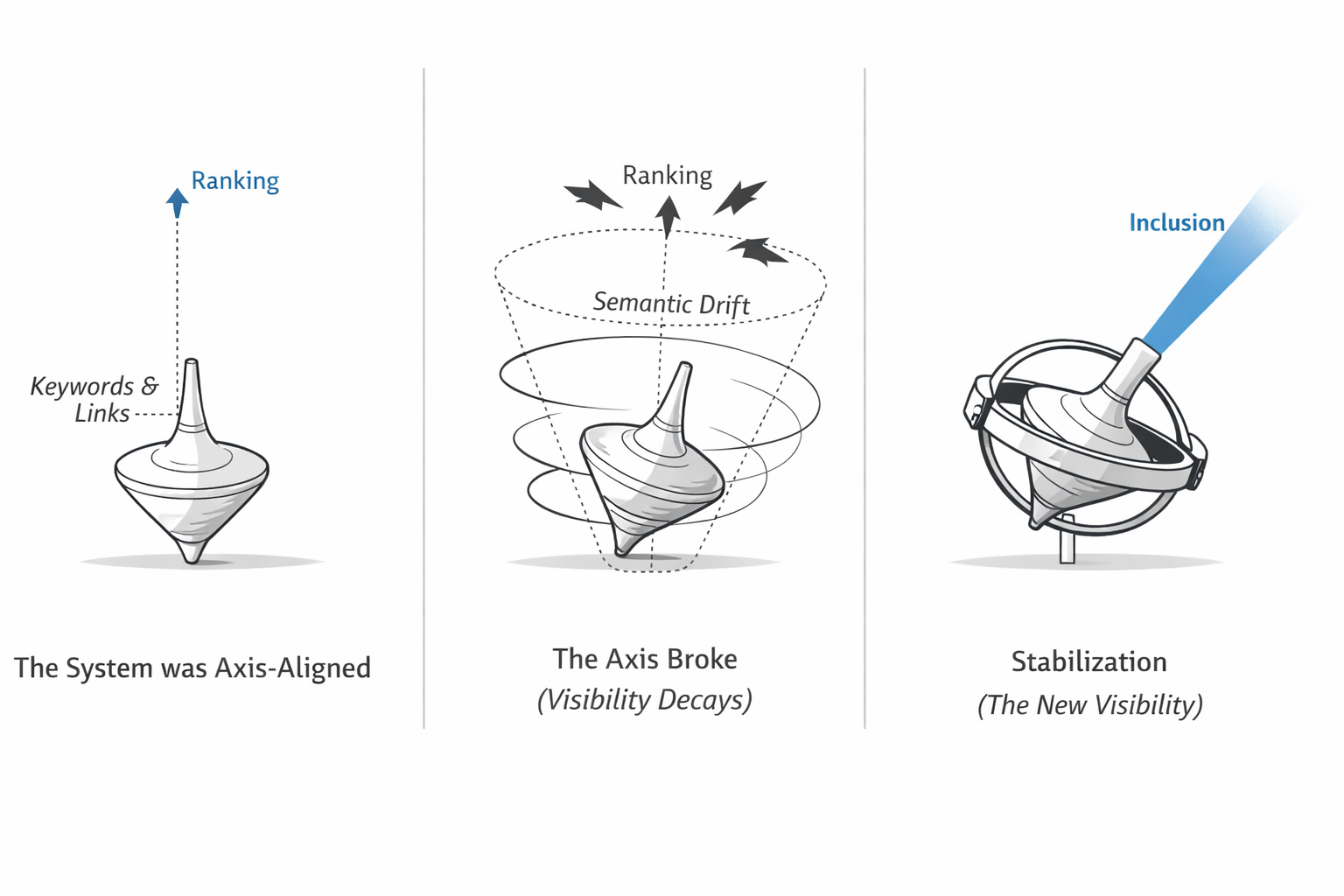
Every few years, SEO is pronounced dead.
This time, the accusation feels sharper. AI search does not show rankings. It does not expose familiar dashboards. It does not leak its machinery. Answers arrive fully formed, confident, and final.
So the conclusion feels obvious: SEO is over.
That conclusion is wrong.
But something did break. And it matters more than rankings. The fundamental shift isn't that SEO stopped working—it's that the feedback loop disappeared. Brands that built entire strategies around positional metrics suddenly found themselves optimizing in the dark, unable to measure what was once their primary success indicator.
What broke was the axis brands optimized around.
SEO worked because the system had an axis
Classic search was never transparent. But it was axis-aligned.
You could point to a keyword.
You could trace a ranking.
You could attribute movement to proxies: links, structure, repetition, authority signals Google documented.
Those proxies were imperfect, but they were stable enough to organize strategy around. Visibility felt mechanical. Improvement felt directional. The system wobbled, but the axis held.
SEO worked not because we understood search, but because the system allowed local optimization without global understanding.
AI search removes that axis.
(If the opacity feels overwhelming, understand that AI search has always been a black box—what changed is how feedback is delivered.)
What actually broke
AI systems do not rank pages. They synthesize answers.
There is no leaderboard. No positional feedback. No clear boundary between first place and invisibility. The system compresses the web into language and presents a finished result—a shift documented in research on large language model adaptation and natural language understanding systems.
This feels like chaos, but it is not.
What disappeared was not visibility.
What disappeared was legibility.
When the axis vanished, brands kept optimizing anyway. But without a stable reference, optimization turned into noise.
This is where wobble enters the system.
Visibility now fails through wobble
In the AI web, brands do not disappear suddenly.
They destabilize.
Their explanations shift.
Their terminology drifts.
Their framing fractures under paraphrase.
When an AI system compresses, recombines, and normalizes language, unstable meaning wobbles. And wobble is punished.
Inclusion now goes to brands whose explanations remain stable under compression.
This is the replacement for proxies.
What replaces rankings operationally
AI systems reward inclusion, not position.
But inclusion is not abstract. It is conditional.
In practice, inclusion depends on three things:
Whether your core explanations remain stable when paraphrased.
Whether your framing aligns cleanly with adjacent sources rather than fighting them.
Whether your content is structurally retrievable when the system looks for material in your domain.
When any one of these breaks, visibility decays silently—even if traffic does not.
This is no longer an SEO problem.
It is a stabilization problem. (What LLMs Actually Read explores these compression dynamics in depth.)
SEO's new place in the hierarchy
SEO did not disappear.
It survives as a Tier-3 signal.
Crawlability still matters.
Structure still matters.
Baseline discoverability still matters.
But treating SEO as a primary visibility strategy is no longer conservative. It is malpractice.
SEO contributes to inclusion.
It does not determine it.
The primary system now operates upstream, inside synthesis—where semantic understanding and structured data matter more than traditional ranking signals.
What Newtation actually stabilizes
Newtation does not optimize pages.
It stabilizes meaning.
When systems compress language, we diagnose where a brand's explanations wobble. When synthesis blurs distinctions, we re-anchor them. When framing collapses under paraphrase, we rebuild the axis.
This is not content production.
It is semantic stabilization.
The output looks like clarity.
The effect is inclusion.
What brands should stop measuring
Rank movement.
Isolated keyword performance.
Page-level attribution models.
These were artifacts of the old axis.
They now lag reality.
What brands should measure instead
Whether their explanations survive compression.
Whether their language remains consistent across contexts.
Whether AI systems reproduce their framing or replace it.
These are not marketing metrics.
They are system diagnostics.
The uncomfortable conclusion
SEO did not die.
But the axis that made it actionable did.
In the AI web, visibility degrades when meaning destabilizes. Brands do not fail because they lack content. They fail because their explanations cannot survive synthesis.
The systems are already deciding.
The only open question is whether your meaning holds.
Related reading:
- What LLMs Actually Read — Understanding synthesis and compression
- Why AI Search Is a Black Box — How to engineer strategy in opaque systems
Want to Close Your AI Visibility Gap?
Get a diagnostic audit that maps all five signal categories for your brand, identifies where you're losing citation space to competitors, and delivers a prioritized remediation roadmap within 14 days.
Request Your AI Visibility AuditCo-Founder & Tech Lead at Newtation. Keshav builds the systems and frameworks that make brands machine-recognizable, from structured data infrastructure to citation-grade content strategies.
More by Keshav ParsaiRelated Articles
What LLMs Actually Read When They Answer a Query
LLMs don't read the internet like humans. Understanding what they actually consume is the difference between guessing at visibility and engineering it.
Your Brand Exists in Two Realities. Most Marketers Only Know One.
What AI models believe about your brand — and why entity drift is the most dangerous gap in modern marketing.
Why AI Search Is a Black Box (and Why That's Not New)
The uncomfortable truth: search was always a black box. The only thing that changed is that it stopped pretending to be clear.