ChatGPT Ads: the facts, the risks, and what actually changes
ChatGPT is about to become an ad surface. Here's what OpenAI has confirmed, why this surface behaves differently, and practical rules for advertisers.
ChatGPT is about to become an ad surface, but it’s not just “search with a chat UI.” It’s a different kind of attention, a different kind of intent, and a different set of risks. Below is a compact article with the facts, the likely downstream effects, and practical examples you can use to think through strategy.
The core facts (what OpenAI has said and what reporters confirm)
- OpenAI will start testing ads in ChatGPT for logged-in adults in the U.S., showing ads in the Free and Go tiers while exempting paid/pro/enterprise tiers. Ads will be clearly labeled and separated from the assistant’s answers.
- OpenAI says ads will not change the model’s replies and that advertisers will not receive raw conversation data; the company plans to provide controls (why you saw an ad / dismiss reasons).
- Early reporting suggests OpenAI expects high advertiser demand and premium pricing, with analysts forecasting big long-term ad revenue potential if measurement and trust are handled correctly.
- Publication timelines indicate impression-based placements could be available quickly (reports point to initial launches around February in press coverage).
Why this surface behaves differently, the three tight points
-
Ads meet formed intent, not raw intent.
When people ask a question in chat they’re often mid-reasoning: assumptions are surfaced, tradeoffs considered, uncertainty reduced. An ad that repeats generic claims competes with the freshly delivered answer, and it loses. (Example: after an answer comparing two laptops, a generic “buy our laptop” will feel tone-deaf.)
-
Trust is conversational, not transactional.
Chat conversations feel like a person helping you. Overstated or unverifiable claims (“#1”, “guaranteed”) erode that feeling quickly. The social contract is fragile: if the ad feels like an intrusion, users notice and remember it.
-
Context matters more than keywords.
In chat a single prompt captures situation, constraint, and intent. “Laptop that runs Excel models all day” ≠ “best laptop.” Ads must resolve an immediate constraint (battery under spreadsheet load; shipping time; campus discounts), not a broad category.
(Those are practical differences - not opinion. The ad placement and privacy framing from OpenAI make these distinctions relevant.)
Measurement and landing are the real engineering problems
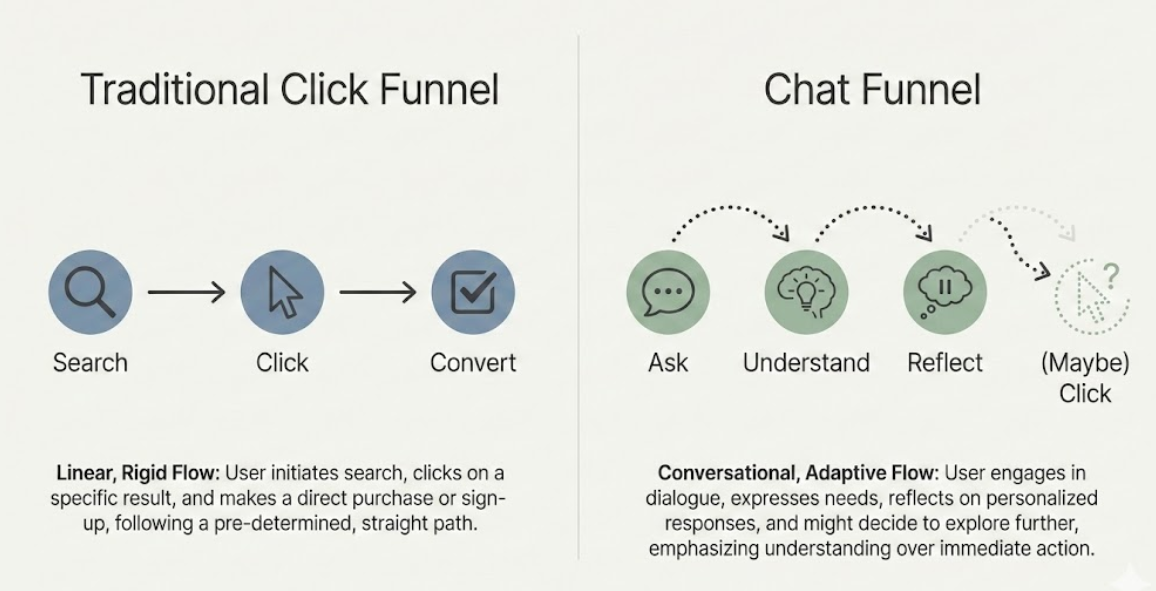
Traditional click funnels assume: search → click → convert. Chat funnels look like: ask → understand → reflect → (maybe) click. That breaks attribution. Reporters note current advertiser signals will be limited early on (impressions, clicks) with richer measurement arriving later — so expect noisy ROAS signals initially.
Landing continuity is critical. If the user just read a focused comparison, landing them on a generic homepage restarts the conversation and kills conversion probability. A one-page “continue the chat” flow (curated comparison table + chat widget that inherits the prompt) preserves intent and reduces drop, and this option will be provided in the upcoming ChatGPT ads.
Practical rules (short & actionable)
- Do not use vague superlatives. If you can’t support a claim quickly, don’t make it.
- Deliver one micro-delta. Ads should add one new, verifiable fact the assistant didn’t give (e.g., “11.5 hours battery under spreadsheet load” or “ships within 48 hours in India”).
- Design landing pages as continuation, not a restart. H1 should echo the user’s prompt; CTA should be “Compare specs for X constraint” or “Show campus pricing.”
- Start with narrow prompts. Pick 10 highly specific conversational prompts and write one delta per prompt. Learn small, iterate fast.
- Instrument simply but early. Capture impressions → clicks → micro-interaction (chat conversion) even if attribution is limited.
(These are practical habits informed by how conversational context shapes relevance and attention.)
What to watch next
- Will OpenAI broaden ad measurement and allow advertiser APIs for conversion signals? That will determine whether ChatGPT ads scale like search/display ads.
- How fast will other assistants (Gemini, Claude) respond with their own ad or privacy stances? Competitive moves will shape user expectations.
One final, simple takeaway
ChatGPT ads won’t reward louder creative. They’ll reward precision, one credible fact, and a landing that continues the conversation. If you treat this like “search 2.0,” you’ll underperform. If you treat it like “helpful interruption,” you’ll learn quickly and keep user trust intact.